
Vertical Contour Bandsaw Blades: Width, Radius and Pitch
A vertical saw lives or dies on blade choice. Go too wide and it won't make the curve. Go too narrow and it wanders on the straight runs and breaks sooner than it should. Go too coarse on thin plate and you strip teeth in the first minute.
The rule we give everyone who calls: run the widest blade that will make your tightest radius, and keep at least three teeth in the material. The picker below does the arithmetic, and prices the blade if you give it your saw's blade length.
Which blade will make your curve?
Enter the tightest radius on the part and the plate thickness. You get the widest blade that makes the turn and the pitch to run, and a price once you put in your blade length.
Measured to the inside of the curve. A 4 in hole is a 2 in radius.
It is on the saw’s nameplate, or look your saw up.
| Blade width | Min. radius | mm |
|---|---|---|
| 1/4 in (6 mm) | 5/8 in | 16 |
| 3/8 in (10 mm) | 1-7/16 in | 37 |
| 1/2 in (13 mm) | 2-1/2 in | 64 |
| 5/8 in (16 mm) | 3-3/4 in | 95 |
| 3/4 in (19 mm) | 5-7/16 in | 138 |
| 1 in (25 mm) | 7-1/4 in | 184 |
Width and radius
The chart is the standard one for set blades. A 1/4 in blade turns a 5/8 in radius, a 1/2 in blade turns about 2-1/2 in, and a 1 in blade needs over 7 in. Those are minimums. Push past them and the back of the blade binds in the kerf and twists, and you either crack it or burn it.
If a part has one tight corner and a lot of gentle curve, don't drop to a narrow blade for the whole job. Make relief cuts: cut straight in to the line in a few places around the tight spot so the waste falls away in pieces and the blade isn't fighting the back of the cut. A wider blade with relief cuts cuts straighter and lasts longer than a narrow one doing everything.
Tooth pitch
Three teeth in the work is the minimum. Fewer than that and each tooth takes too big a bite and gets knocked off. On sheet and thin plate that means a fine pitch, 14 to 18 TPI. As the material gets thicker, go coarser so the gullets have room for the chip: about 10 TPI at 3/8 in, 6 to 8 TPI from 1/2 to 3/4 in, 3 or 4 TPI once you're past an inch.
Too fine on thick plate is the opposite problem. The gullets fill before the tooth clears the cut, the blade stops cutting and starts rubbing, and it overheats. If you're pushing hard and getting dust instead of chips, the pitch is too fine.
Speed and feed
Carbon blades don't like heat. Mild steel wants a moderate band speed, somewhere in the low hundreds of feet per minute depending on thickness. Stainless and tool steel want it much slower. Aluminum, brass and plastics will take several times faster. Start from the speed chart on your saw and adjust from there.
Then read the chips. Curled, silver chips mean you're about right. Blue or brown chips mean too much speed or too much feed. Fine powder means the blade is rubbing, usually because it's dull or the pitch is too fine.
Carbon or bi-metal on a contour saw
Most contour work is carbon. Our CS-1 has a flexible back that's happy on the smaller wheels of a vertical saw and on tight radii, and it's the least expensive blade we sell. Bi-metal makes sense on a vertical saw doing mostly straight cuts in stainless or tool steel, as long as the wheels are big enough for it. Our bi-metal starts at 3/4 in wide, so anything tighter than about a 5-1/2 in radius is a carbon job anyway.
Blade length
It's on the nameplate on most saws. If the plate is gone, look the saw up on our blades by machine page, measure an old blade, or call with the make and model. We weld every blade to length in Hamilton, usually within 1 to 2 business days.
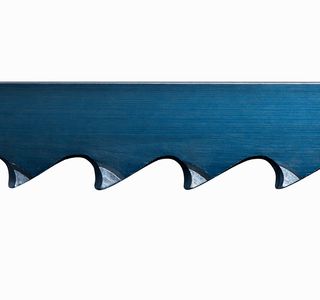
Custom welded to your machine's exact loop length at our Hamilton, Ontario facility.
Configure & Order