
Cutting Case-Hardened Steel with a Bandsaw (RC60)
We get this question a lot, usually after someone has burned through two or three bi-metal blades on the same job: what blade cuts case-hardened steel at 60 Rockwell C?
The short answer: a carbide-tipped blade with negative rake geometry. On our shelf that is the Arntz Silver-Line N. The longer answer is worth reading before you spend money, because case-hardened material punishes the wrong blade fast.
Why your bi-metal blade is glazing over
Case hardening puts a thin skin of very hard material, typically 55 to 65 HRC and anywhere from half a millimetre to a few millimetres deep, over a softer core. The teeth on an M42 bi-metal blade run about 67 to 68 HRC. Against a 60 HRC case, that leaves almost no hardness advantage. The tooth cannot bite, so it rubs. Rubbing makes heat, heat draws the temper out of the tooth tip, and within a few cuts the blade is polishing the workpiece instead of cutting it. People often describe the blade as "glazed" or say it "just stopped cutting." Nothing was defective. It was the wrong tool for the skin it was asked to break.
What actually works
Carbide tooth tips sit around 90 HRC equivalent, far above any case-hardened surface, so they cut instead of rub. The Silver-Line N pairs carbide tips with a negative rake angle. Negative rake matters here: instead of a sharp positive edge that chips when it slams into hard skin, the tooth presents a stronger, slightly blunted face that shears the case in a scraping action and survives the entry shock. Multi-chip geometry splits the cut across the tooth set, which keeps individual tips loaded within their limits.
Setup matters as much as the blade
- Slow the band down. Hard material wants low band speed. If your machine is set up for mild steel, cut the speed roughly in half as a starting point and listen to the cut.
- Keep the feed firm. The worst thing you can do is feather the feed. Teeth that ride on the case without penetrating it are rubbing, and rubbing kills carbide too, just slower. Enough feed pressure to keep each tooth biting under the skin, always.
- Clamp rigid. Case-hardened stock that vibrates chips carbide tips. Solid vise pressure, short unsupported lengths.
- Flood the cut. Full coolant, not mist, if your machine allows it. Heat is the enemy on both sides of the cut.
When bi-metal is still the right call
If the case is thin, the part count is low, and you can accept losing some blade life, a fresh M42 blade with a fine pitch can get through a job. It is a cost decision, not a capability decision, and it stops making sense the moment you have more than a handful of cuts to make. For repeat work in hardened stock, carbide pays for itself quickly in blades you do not throw away.
Getting one for your saw
Every Silver-Line N we sell is welded to your machine's exact loop length here in Hamilton, Ontario. If you know your blade length, order straight from the product page. If you know your machine but not the blade spec, find it on our blades by machine page. If you are not sure the material you are cutting is case-hardened or through-hardened, call us at 1 (800) 957 2690 and describe the job. Through-hardened stock is a different conversation and we would rather have it before you buy a blade than after.
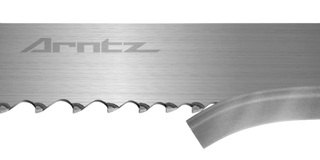
Custom welded to your machine's exact loop length at our Hamilton, Ontario facility.
Configure & Order